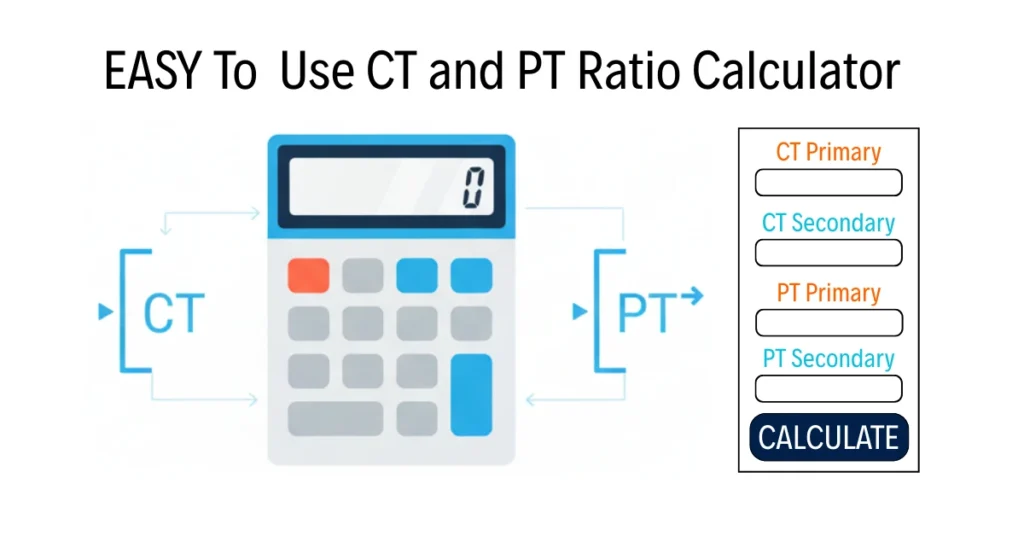
When configuring the energy meters, the CT and PT ratio calculator must be accurately calculated and set. A small mistake in these settings can lead to major billing or monitoring errors. To save time and ensure accuracy, we’ve built a free CT/PT Ratio Calculator that helps electrical engineers, technicians, and automation professionals quickly determine the correct ratio values.
Table of Contents
What is the CT and PT Ratio?
➤ CT Ratio:
The ratio between the primary current (actual load) and the secondary current (fed to the meter or protection device).
CT Ratio = Primary Current / Secondary Current
Example:
A CT with 600/5 rating → CT Ratio = 600 ÷ 5 = 120
➤ PT Ratio:
The ratio between the primary voltage (line voltage) and the secondary voltage (fed to the meter).
PT Ratio = Primary Voltage / Secondary Voltage
Example:
A PT with 11kV/110V → PT Ratio = 11000 ÷ 110 = 100
Use the Free CT and PT Ratio Calculator
Why Use a CT/PT Calculator?
- Eliminates manual calculation errors
- Saves time during site commissioning
- Useful for meter setup, energy audits, and system design
- Beginner-friendly for students and junior engineers
Important Tips for CT/PT Configuration
| Aspect | Recommendation |
| CT Polarity | Always match ‘P1’ to source side |
| Accuracy Class | Use 0.5 or better for metering |
| Secondary Load | Do not leave CT secondary open |
| PT Fusing | Always fuse PT secondary to avoid faults |
Tools You May Need
- Clamp Meter with CT Range
- Digital Multimeter – True RMS
- Protective Fuse Box for PT Secondary
Final Thoughts
A reliable CT/PT ratio calculator simplifies a critical task in electrical system design and maintenance. Bookmark this page and use it every time you’re configuring a new MFM meter or protection relay.
Here’s a set of FAQs suitable for your “CT and PT Ratio Calculator” page on CtrlVolt.com.
Frequently Asked Questions (FAQs)
What is CT ratio?
A: CT ratio — or Current Transformer ratio — is the ratio of the primary current (in a high-current circuit) to the secondary current delivered by a Current Transformer (CT). For example, a CT with rating “600/5” means that when 600 A flows through primary, the CT secondary gives 5 A.
What is PT ratio (or VT ratio)?
A: PT ratio — or Potential Transformer (Voltage Transformer) ratio — is the ratio of the primary voltage to the secondary (stepped-down) voltage from a Potential Transformer (PT / VT). For example, an 11 kV/110 V PT has a ratio of 100:1.
Why do I need a CT & PT ratio calculator?
A: Because manual calculation of CT and PT ratios can be error-prone, especially in complex systems. The calculator helps ensure accurate scaling for metering and protection devices, reduces human error, and saves time.
What formula does the calculator use?
A:
- CT Ratio = Primary Current ÷ Secondary Current.
- PT Ratio = Primary Voltage ÷ Secondary Voltage.
What inputs do I need to use the tool?
A: You need:
- Primary current (in amps) and secondary current (in amps) for CT ratio.
- Primary voltage and secondary voltage (in volts) for PT ratio.
What does the result tell me?
A: The result gives you how much your transformer is scaling the current or voltage — i.e. from high-voltage/current to measurable lower values. This helps for setting up meters, relays, and ensuring correct calculations for metering and protection.
Can the ratio be non-integer (decimal)?
A: Yes — depending on the input values, the ratio may come out as a decimal (if primary and secondary values are not integer multiples). The calculator handles such cases as long as correct numerical inputs are provided. (This behavior aligns with standard ratio calculation logic.)
Is this calculator tool free to use?
A: Yes, the CT and PT ratio calculator on CtrlVolt.com is provided free — no subscription or payment needed. It’s designed for engineers, technicians, and students.
Are CT and PT calculators sufficient for real-world metering and protection design?
A: The calculator provides ideal ratio values, but real-world use requires also checking transformer class, burden, wiring, and compliance with standards. Instrument transformers may introduce ratio or phase errors under load or non-ideal conditions.
What happens if I enter invalid inputs (e.g. zero, negative)?
A: The calculator will likely return an error or invalid output — for meaningful results, you must input valid, positive primary and secondary current/voltage values (in correct units).